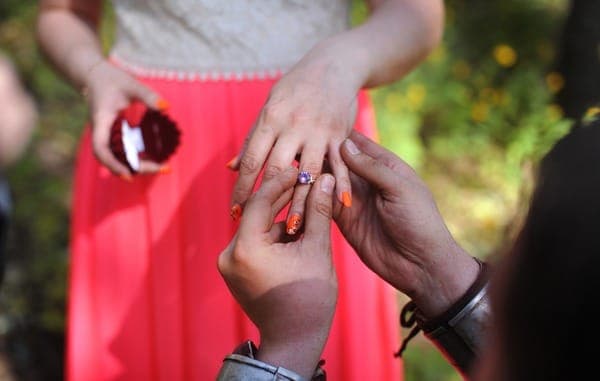
Getting married in Switzerland: how the civil wedding works

Contents9 sections
In Switzerland, only one ceremony makes you legally married: the civil wedding at a civil registry office. A church wedding or a celebrant-led ceremony can follow, but it never replaces the civil one. This guide explains how the civil wedding works — for couples who live in Switzerland and for couples who are coming from abroad to marry here.
The short version
- Only the civil wedding is legally binding. It takes place at a civil registry office (Zivilstandsamt in German, état civil in French, stato civile in Italian).
- Both partners must be at least 18. Since 1 July 2022, marriage in Switzerland has also been open to same-sex couples.
- First comes the preparatory procedure. You submit your documents and both confirm in person that you meet the conditions for marriage.
- Then you have three months. Once the procedure has been completed, the wedding has to take place within three months.
- You need two witnesses. Both must be adults and must bring a valid passport or identity card.
- A religious ceremony comes afterwards. Swiss law does not allow a religious wedding to take place before the civil one.
Step 1: the preparatory procedure
Before any civil wedding, the civil registry office checks that you are allowed to marry. This is called the preparatory procedure (Ehevorbereitungsverfahren).
- Where: if at least one of you lives in Switzerland, the civil registry office at that place of residence is responsible. If you both live abroad, the procedure usually runs through the Swiss embassy or consulate in your country of residence, or directly with the registry office where you want to marry.
- In person: both of you have to attend. At the end you sign a declaration confirming that you meet the conditions for marriage.
- Documents: the office tells you exactly which documents you need — it depends on your nationality, your civil status and where you were born. Documents must be originals (no photocopies) and must not be older than six months. They are not returned.
- Foreign documents: they may have to be checked, which can take several months and is at your expense — so start early.
- Language: you need to understand what you are signing. The city of Zurich, for example, runs the preparation in German or English and otherwise asks you to bring an interpreter.
Step 2: getting the timing right
When the preparatory procedure has been completed successfully, the registry office confirms that you can marry. From then on, you have three months to hold the wedding.
The exact timing differs from office to office. Two examples:
- City of Zurich: a wedding date can be reserved up to 12 months ahead. The preparation starts no earlier than three months before the date and has to be completed at least one month before it.
- Canton of Bern: dates can be booked no more than one year in advance.
If you are coming from abroad or have foreign documents, allow several months for the paperwork before you commit to a date with your venue and vendors.
Step 3: the ceremony
- Any registry office in Switzerland: the preparatory procedure is done where you live, but the wedding itself can take place at any civil registry office in the country. Many couples choose a registry office close to their venue.
- Special locations: many registry offices have their own wedding rooms, and some also hold ceremonies at selected locations such as castles or historic buildings. Weddings on a Saturday or at an external location usually cost extra.
- Sundays and public holidays: some cantons, such as Aargau, do not hold civil weddings on Sundays and public holidays — check with your office.
- Witnesses: two adults with legal capacity. They show a valid passport or identity card and must understand the language of the ceremony.
- Language: ceremonies are held in the official language of the place. Some offices also marry couples in English — the city of Zurich, for example, asks for your preferred language when you reserve a date. If you do not understand the language of the ceremony, you need an interpreter at your own expense, who must not be a close relative.
What does a civil wedding cost?
The fees are set by the authorities and depend on the office, the day and the location. For the preparatory procedure and a ceremony during normal office hours, expect a few hundred francs in total — in the city of Zurich, for example, the cheapest wedding (at the Stadthaus) costs at least CHF 255. Saturdays, external locations, interpreters and the checking of foreign documents cost extra. Your registry office will tell you the total amount in advance.
Coming from abroad to marry in Switzerland
- Legal residence: if you are not Swiss, you have to prove that you are legally in Switzerland during the preparatory procedure and up to the wedding.
- Visa: depending on your nationality, you may need a visa — a Schengen visa for stays of up to 90 days, or a national visa for longer stays. If the foreign spouse is going to live in Switzerland after the wedding, a visa and a residence permit are needed. The Swiss representation in your country will tell you what applies.
- Proof from your home country: couples who live abroad and do not hold a Swiss passport usually need a certificate of no impediment to marriage (a marriage eligibility certificate) from their home country.
- Plan early: the checking of foreign documents can take several months. Contact the Swiss embassy or consulate as soon as you have a rough date in mind.
Civil wedding, church wedding, celebrant-led ceremony
Many couples in Switzerland marry at the registry office in a small circle and celebrate afterwards with all their guests — often with a church wedding or a celebrant-led ceremony at the venue. The celebrant-led ceremony is not legally binding, but it is completely free in place, length and language: in a garden, by a lake or in the mountains. You can find wedding celebrants in Switzerland and wedding venues on Hochzeitsuche.
Frequently asked questions
Can we get married in Switzerland if neither of us lives there?
Yes. The preparatory procedure then usually runs through the Swiss embassy or consulate in your country of residence. You have to be legally in Switzerland for the wedding, with a visa if your nationality requires one. Allow several months for the paperwork.
Do we need witnesses?
Yes. Swiss civil weddings take place in the presence of two adult witnesses, who have to show a valid passport or identity card.
Can the civil ceremony be held in English?
That depends on the registry office. Some offices marry couples in English — say which language you would like when you book. Otherwise, the ceremony is held in the local language and you bring an interpreter.
Is a celebrant-led ceremony legally valid in Switzerland?
No. Only the civil wedding at the registry office is legally binding. A celebrant-led or religious ceremony can take place afterwards, on the same day or later.
Sources
The rules come from the Swiss Civil Code; the details differ from office to office. We checked the following official sources in September 2026:
- Federal Department of Foreign Affairs: Marriage to be performed in Switzerland
- City of Zurich: marriage preparation and questions and answers (in German)
- Canton of Bern: getting married (in German)
- Canton of Aargau: civil wedding (in German)
Rules and fees can change. Always confirm the details with the civil registry office that will handle your wedding.