Which hand is the wedding ring worn on in Switzerland?
Contents8 sections
The venue is booked, the guest list is done and the excitement is growing. In the middle of this wonderful but busy time comes a step full of symbolism: choosing your wedding rings. And then a question comes up that puzzles a surprising number of couples: which hand is the wedding ring worn on in Switzerland — the left or the right?
It is more than a question of style: the answer is rooted in tradition, history and symbolism. You may have heard different views from friends and family, and you are not alone in being unsure. This guide explains which hand is traditional in Switzerland and the romantic idea behind it, where the engagement ring goes, how Swiss customs compare with other countries, and the practical points that can help you make the choice that feels right for both of you.
The Swiss tradition: the left hand
Let's answer the key question straight away. In Switzerland, unlike in some neighbouring countries, the tradition is mostly to wear the wedding ring on the ring finger of the left hand. Why the left? Behind it lies a lovely and very old idea that gives your rings even more meaning.
The vena amoris: a direct line to the heart
The main reason for wearing the wedding ring on the left goes back to an ancient myth: the vena amoris, Latin for "vein of love". The ancient Romans and Egyptians believed that a special vein ran directly from the ring finger of the left hand to the heart.
Wearing the wedding ring on exactly this finger symbolically seals the bond between two loving hearts. The ring, a symbol of eternity without beginning or end, is connected directly to the source of love. Anatomy has since shown that no such single vein exists, but the romantic symbolism has survived for centuries and still shapes the tradition in Switzerland and many other Western countries.
Are there exceptions?
The left hand dominates in Switzerland, but the rule is not set in stone. Switzerland is known for its diversity, and that is reflected in its wedding traditions too.
- Regional influences: in some cantons or families, especially those close to Germany or Austria, it can be quite usual to follow the custom there and wear the wedding ring on the right hand. There is no nationwide rule.
- Religion: denomination can play a part too. While the left hand is preferred in many regions with a Catholic tradition, the right hand is more usual in some Protestant traditions.
- Personal choice: today, the most important rule is that there are no fixed rules any more. Many couples make a deliberate choice for personal or practical reasons. What matters is that the choice feels right for you as a couple and reflects your own story.
And the engagement ring?
Before the wedding ring finds its place, there is another important piece of jewellery: the engagement ring. Where it is worn is closely linked to the wedding ring tradition, and knowing this helps to avoid confusion.
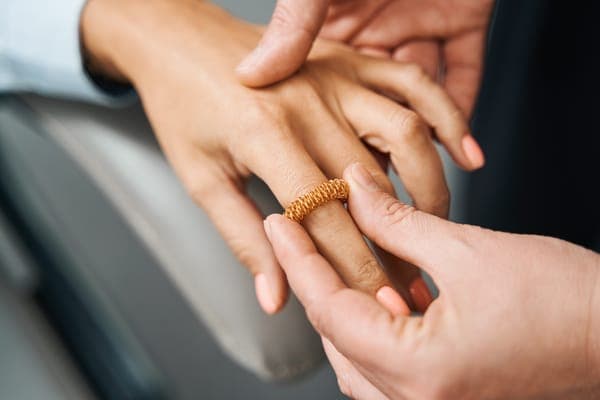
In Switzerland, the engagement ring is traditionally worn on the ring finger of the left hand as well. There is a logical reason for this: the left ring finger is, so to speak, reserved for the future wedding ring. Wearing the engagement ring there signals that this place is meant for lasting love. It is a visible promise, worn on the finger that the vena amoris connects directly to the heart.
What happens to the engagement ring after the wedding?
The big day arrives, the rings are exchanged and the wedding ring slides onto the left ring finger. But what happens to your beautiful engagement ring? Many brides ask themselves this. Fortunately, there are several popular and stylish options:
- Move it to the right hand: a very common and elegant solution. The engagement ring, worn on the left until the wedding, simply changes sides and is worn on the right ring finger from then on. Both rings are shown off, and each has its own symbolic place.
- Wear both together (stacking): an increasingly popular trend. The engagement ring stays on the left ring finger and is worn together with the wedding ring, which joins it at the ceremony. This looks especially good if the two rings are designed to match, and it symbolises the promise of the engagement flowing seamlessly into the promise of marriage.
- Keep it for special occasions: some women keep the engagement ring safe after the wedding and wear it only on special occasions. That can be a good choice if the ring is very delicate or eye-catching and would get in the way in everyday life.
So the question of which hand the engagement ring goes on in Switzerland has a clear answer: traditionally the left. What happens afterwards leaves room for your own personal style.
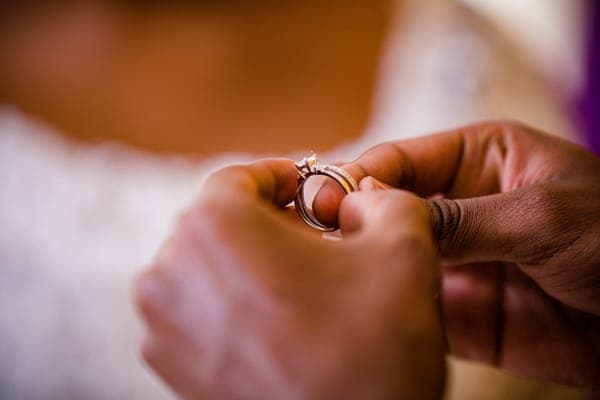
Left or right? How other countries do it
The uncertainty about the right hand for the wedding ring often comes from the fact that customs vary widely from country to country. A look beyond Switzerland's borders helps to understand this variety and to put your own tradition in context.
The right hand: Germany, Austria and others
In many countries, including Switzerland's immediate neighbours Germany and Austria, the wedding ring is usually worn on the right hand. There, the engagement ring is worn on the left and moves to the right ring finger at the wedding. This tradition also has historical roots: according to some sources, the right hand was considered the "rightful", "good" or contract-sealing hand, which is why the marriage vow was sealed with a ring on it.
Other countries where the wedding ring is often worn on the right include:
- Norway
- Poland
- Bulgaria
- Russia
- Ukraine
The left hand: the US, the UK, France and others
With its left-hand tradition, Switzerland is in good company. Most Western countries follow the myth of the vena amoris. They include:
- the United States
- Canada
- the United Kingdom
- France
- Italy
- Portugal
- and many more.
This international variety shows that there is no universal right or wrong. The choice of hand is a cultural and personal decision.
A symbol with a history: why the ring finger?
Have you ever wondered why it has to be the fourth finger, of all fingers? The history of the wedding ring and where it is worn goes back thousands of years and is full of fascinating symbolism.
In ancient Egypt, rings of woven reeds were already exchanged as a sign of love and commitment. The circle, without beginning or end, was the perfect symbol of eternity. The Romans adopted the custom and forged their rings from iron, to symbolise the permanence of the marriage vow.
As mentioned above, the belief in the vena amoris fixed the ring's place on the fourth finger of the left hand. The idea was so powerful that it spread through the Roman Empire and has survived in many cultures to this day. So a ring on this finger is more than a piece of jewellery: it is an echo of love stories thousands of years old.
Beyond tradition: practical considerations
Besides all the symbolism and tradition, there are also very practical reasons that can influence your choice between the right and the left hand.
- Right- or left-handed: the vast majority of people are right-handed. That means the right hand is more active in everyday life and takes more strain (writing, housework, sport). Wearing a valuable wedding ring on the left, more passive hand protects it from scratches and wear. For left-handers, of course, the opposite applies: for them, the right hand could be the safer choice.
- Work and safety: in some jobs, wearing a ring can be dangerous (working with machinery, for example) or get in the way (in healthcare, for example). Couples then often consider wearing the ring on the less dominant hand, or taking it off at work altogether.
- Comfort: in the end, it is also a matter of feel. On which hand does the ring simply feel better and more natural to you? Try it out: wear a ring on your left hand for a few days and then on your right, to get a feel for it.
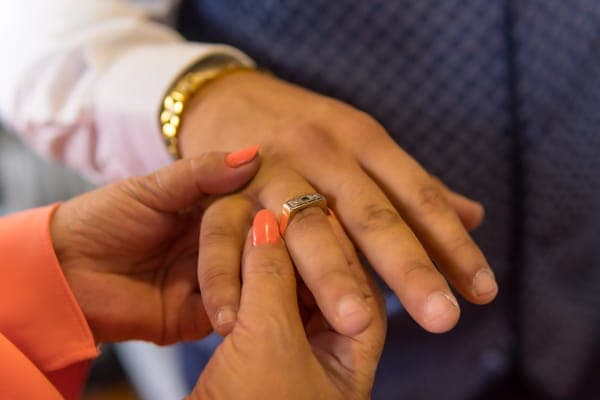
When traditions meet: an example
Imagine a fictional couple. Anna is from Zurich, and for her it was always clear that the wedding ring goes on the left. Her fiancé, Lukas, comes from Munich and has only ever known it on the right. Planning the wedding leads to a loving debate. What should they do?
They talk about what matters to them. Anna loves the romantic idea of the vena amoris; Lukas likes the symbolism of the "rightful" hand. Rather than insisting on one tradition, they find their own solution: they decide to wear their rings on the left, to honour the connection to the heart that means so much to Anna. But at formal occasions back home in Germany, Lukas will sometimes move his ring to the right, as a sign of respect for his family's tradition. Their compromise honours both cultures and tells their very own story.
Frequently asked questions
Do both partners have to wear their ring on the same hand?
No, not at all. There is no rule that says so. If one partner prefers the right hand for practical reasons (as a left-hander, for example) while the other chooses the left, that is perfectly fine. The rings are your shared symbol, but comfort is individual.
Can I switch hands later?
Yes, of course. Life changes. After a few years you may find that the ring is more practical on the other hand, or simply feels better there. The meaning of the ring lies in the symbol itself, not in where it sits.
What if I cannot wear a ring at work?
Safety always comes first. Many people in manual trades or medical professions cannot wear a ring. Popular alternatives are wearing the ring on a chain around your neck or getting a ring tattoo on your ring finger.
Your love, your decision
Traditionally, the question of where the wedding ring is worn in Switzerland has a clear answer: on the ring finger of the left hand, as a symbol of the direct connection to the heart. Until the wedding, the engagement ring keeps that place for it.
But the modern answer is even simpler, and much lovelier: wear it wherever it feels best for you as a couple. The days of rigid rules are over. Whether you follow the romantic vena amoris, put practical considerations first or, as an international couple, create a tradition of your own, every choice is right as long as you make it together and with love. Your ring is the symbol of your unique bond, and only you set the rules for it.